
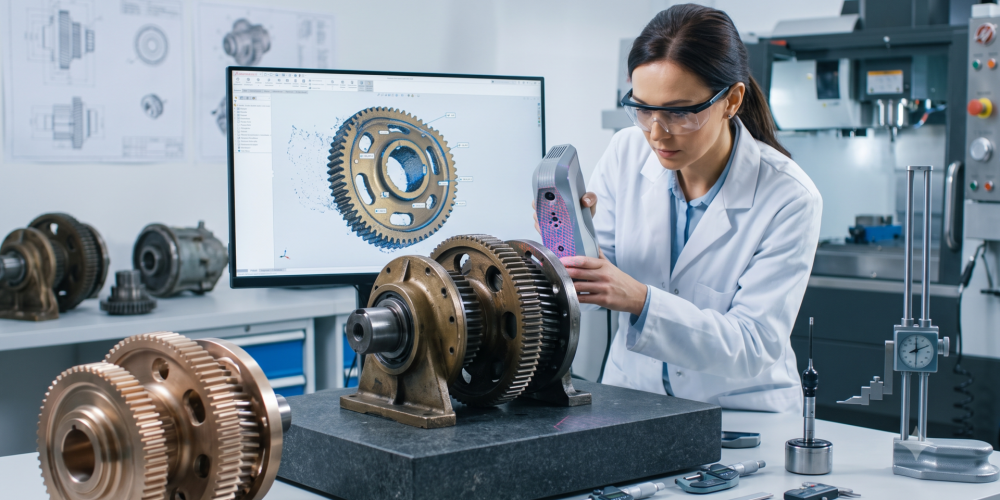
There is one phrase that maintenance managers across Indonesia fear the most: the component is discontinued. The machine is still healthy, the frame is still strong, the system still works, but one small component breaks and the manufacturer stopped making it ten years ago. Suddenly, a multi-billion rupiah asset turns into an expensive metal statue.
The good news is, that component wasn’t born from magic. It was born from engineering drawings, specific materials, and a machining process that can be understood. If a component was ever made, it can be remade. This is the job of reverse engineering machine parts: reading backwards from the physical object to the specifications, then moving forward again to a new, functioning component.
Reverse Engineering Machine Parts is Not Just Copying
This needs to be clarified from the start because it is often misunderstood. Copying means imitating the outer shape of an object and hoping the result works. Reverse engineering means understanding why every feature on that component exists, and then recreating it with that understanding. The difference is clearly visible when the component is installed and put under load.
Cloned components usually fit in shape but fail in function because the material is wrong, the heat treatment is ignored, or the critical tolerances are unknown. Properly reverse-engineered components work like the original, and in some cases work better, because the weak points that caused the first failure can be improved in the new design.
Step One: Reading the Damaged Object
Ironically, the components we receive are almost always damaged. That is why they are brought to us. So the first job is to separate which are original dimensions and which are dimensions resulting from wear or deformation. A shaft that is worn on one side cannot simply be measured and turned into a drawing, because you would be reproducing the wear.
This is where experience becomes important. We look for surfaces that never made contact and never received loads, because that is where the original dimensions are still intact. We also study the wear marks to understand the direction of the load and the cause of failure. A fracture tells a story much richer than just numbers.
Step Two: Measurement and Geometric Reconstruction
Measurement is done in layers. Micrometers, height gauges, and bore gauges handle main dimensions with high precision. For contoured surfaces like lobe profiles or complex curved shapes, digital scanning provides a point cloud which is then reconstructed into a three-dimensional model. But a point cloud alone is never enough.
The scanned model must be translated into clear geometry: which parts should be perfect circles, which should be flat planes, and which are intentionally contoured. A scanner will faithfully record every tiny dent. The engineer reading it must know which is design and which is damage. This is the part that cannot be handed over to software.
Step Three: Guessing the Material is Not an Option
In the process of reverse engineering machine parts, the right shape with the wrong material is a delayed failure. Therefore, we determine the material through evidence: hardness testing to estimate the steel grade and its heat treatment, structural observation to identify the type of casting, and composition analysis if necessary. The process marks on the original surface also tell a lot about how the component was made.
We also ask things that are often overlooked: in what kind of environment does this component work? High temperatures, shock loads, or chemical exposure all change the right material choice. This question is not small talk; the answer often changes the entire engineering decision.
Step Four: Prototype, Measure, Install
The first unit is never immediately mass-produced. We make one unit, measure it against the drafted drawings, and physically match it with its mating components. A field fit test closes the gap between theory and reality, because a decades-old machine often has tolerances that have shifted from its factory condition.
Once the first unit is proven, the working drawings and process parameters are frozen. From that point on, you have something far more valuable than a single replacement part. You have the ability to order the exact same component whenever needed, without relying on anyone’s catalog. This capability is the core of our precision component manufacturing services.
When a Component is Not Just a Component
Some jobs don’t stop at one small object. A cracked engine housing, a bent support frame, or misaligned mounts demand structural work. This is where our fabrication services join precision machining, so a unit can be restored as a whole, not as a collection of patches that don’t talk to each other.
We use the same approach to develop components in our product line, because making something from scratch and resurrecting something extinct demand identical engineering discipline.
When is Reverse Engineering Machine Parts Worth Doing?
The math is simple. Compare the cost of making the component with the cost of downtime while waiting, plus the risk of having to replace the entire unit. For machines that are still structurally sound and still making money, the numbers almost always favor remanufacturing. For components that will be needed repeatedly, the value multiplies because the drawing only needs to be made once.
The Opportunity to Improve the Original Design
There is one advantage that machine owners rarely realize. When a component is remade, you are not obligated to repeat its weaknesses. If the original component always breaks at the exact same spot after two years, that spot is telling you that its design is less than perfect for the actual loads it faces in the Indonesian field.
A radius that is too sharp can be enlarged. The material can be upgraded to a tougher grade. Thickness in critical areas can be added as long as it doesn’t interfere with mating components. Changes like this are done with calculation, not guesswork, and are always discussed with you first. The result is a component that lasts longer than the original.
Documentation is a Long-Term Asset
When the process of reverse engineering machine parts is complete, you have a complete engineering drawing with datums, tolerances, material specifications, and process notes. For a company operating a fleet or a production line, this document is an asset whose value increases every year. It eliminates reliance on a single supplier and turns a rare component into one that can be ordered anytime.
We keep the documentation of every job precisely for this reason. When you call two years later to order the same unit, nothing needs to be re-measured, nothing needs to be guessed, and nothing needs to be discussed from scratch.
For us, this work is also a form of respect for the assets you already own. A machine whose frame is still strong and whose systems are still healthy does not deserve to be retired just because one small component is no longer printed in a catalog. As long as the metal can be read, that machine still has a future.
Is there a machine in your facility sitting idle just because one component can no longer be bought? Bring that component to us, in whatever condition it is. Often, the piece of metal you consider scrap is the only remaining technical document, and that is enough to get started.