
Is your engine making a strange ticking sound that you can’t quite place? Perhaps you’ve noticed it doesn’t have the same pulling power it once did. These subtle changes can often point to an issue with one of the engine’s most important components: the camshaft.
The camshaft is like the brain of the engine, precisely controlling its breathing. When it wears out, you face a critical decision that impacts both your budget and your operational downtime. This guide provides a clear cost-benefit analysis of camshaft repair and replacement to help you make the best choice.
Understanding the Camshaft’s Critical Role
The camshaft is a rotating shaft with a series of egg-shaped lobes along its length. As it spins, these lobes push open the engine’s intake and exhaust valves in a perfectly timed sequence. This action allows the air-fuel mixture to enter the cylinders and the exhaust gases to exit.
Think of the camshaft as the conductor of an orchestra, with the valves being the musicians. It ensures every part plays at the exact right moment to create a smooth and powerful performance. If the timing is off even slightly, the entire engine’s efficiency and power output suffer.
Common Signs of a Worn or Damaged Camshaft
A failing camshaft will almost always give you some warning signs before it fails completely. These symptoms are your engine’s way of asking for help. Paying attention to them can prevent more widespread and costly damage to other components.
Recognizing these issues early is key to a successful and cost-effective solution. Here are the most common indicators of camshaft trouble:
- A Rhythmic Ticking Noise: A persistent ticking or tapping sound coming from the upper part of the engine is a classic sign of worn camshaft lobes.
- Engine Misfires: When lobes wear down, valves don’t open fully, which can lead to incomplete combustion and a rough-running engine.
- Loss of Power: You might notice your machinery struggles under load or is slow to accelerate because the engine can no longer “breathe” efficiently.
- Metal Shavings in Oil: During an oil change, finding fine metallic particles in the used oil can indicate that the camshaft lobes are grinding away.
The Big Decision: Factors Influencing Camshaft Repair and Replacement
Choosing between repairing and replacing a camshaft involves more than just the initial price tag. You need to consider the type of damage, the long-term reliability of the solution, and the impact on your operational schedule. A careful evaluation of these factors will lead you to the most sensible decision.
Making an informed choice requires a clear understanding of when each option is most appropriate. A professional assessment is always recommended to determine the true condition of the component. Let’s break down the key considerations.
Analyzing the Damage: When is Repair Possible?
Repairing a camshaft is a viable option when the damage is not catastrophic. This approach focuses on restoring the component to its original factory specifications. It is a highly specialized process that requires precision machinery.
A camshaft is a good candidate for repair if it shows minor to moderate surface wear. This includes issues like lightly scored bearing journals or lobes that have lost some of their lift but are otherwise structurally sound. These problems can often be corrected by a skilled technician.
The Case for Replacement: When is it Necessary?
In some situations, the damage to a camshaft is simply too severe for a safe and reliable repair. In these cases, replacement is the only logical path forward. A new or remanufactured camshaft provides a known-good component that restores engine performance.
You should always choose replacement if the camshaft is bent, cracked, or has severely worn lobes that have lost their hardened surface. Attempting to repair a component with such deep structural damage is risky and likely to fail. A broken camshaft can cause catastrophic engine failure.
Cost Analysis: Short-Term Savings vs. Long-Term Value
On the surface, a repair might seem like the cheaper option. However, you must consider the total cost over the engine’s life. A quality repair can be very effective, but an improper one can lead to another failure down the road.
A replacement camshaft often comes with a warranty, giving you peace of mind and protection against defects. While its upfront cost may be higher, this long-term security can provide better overall value. You must weigh the initial savings of a repair against the reliability of a new part.
Time and Downtime Considerations
Your machinery only makes money when it is running. The time it takes to get an engine back in service is a major factor. You need to ask which option can be completed more quickly.
A replacement can be very fast if the correct part is in stock and readily available. In contrast, a proper repair, involving welding, grinding, and testing, can take several days. You have to balance the repair cost against the cost of having your equipment out of commission.
A Closer Look at the Camshaft Repair Process
When a camshaft is deemed repairable, it goes through a multi-step process to restore its precise shape and function. This is not a simple fix; it is a form of industrial remanufacturing. The goal is to make the component as good as, or sometimes even better than, it was when it left the factory.
The process requires a clean environment, calibrated machines, and a technician with years of experience. Here are the typical steps involved:
- Detailed Inspection: The camshaft is first cleaned and then thoroughly inspected for cracks using methods like magnetic particle testing. Its dimensions are measured with micrometers to determine the extent of the wear.
- Lobe and Journal Welding: A specialized welding process is used to add hardened material back onto the worn areas of the lobes and bearing journals.
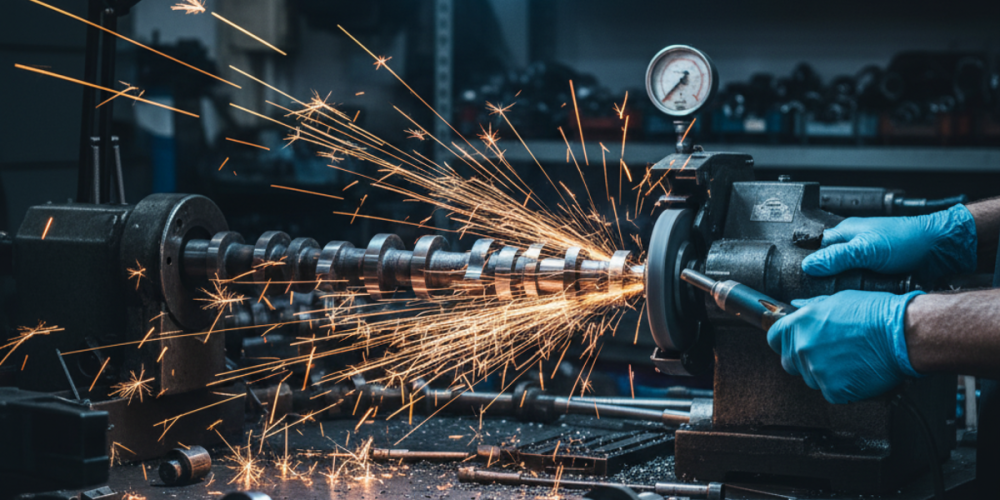
- Precision Grinding: The camshaft is placed on a special grinding machine. This machine carefully grinds the repaired lobes back to their exact original shape, size, and angle.
- Polishing: The bearing journal surfaces are polished to a mirror-like finish. This ensures they can rotate smoothly with minimal friction.
- Final Quality Control: The finished camshaft is checked again for straightness and proper dimensions before it is approved for reinstallation.
Conclusion: Making the Right Choice for Your Engine
The decision between camshaft repair and replacement ultimately depends on a careful analysis of the damage, cost, and required turnaround time. A repair can be a great, cost-effective option for minor wear, while a replacement offers certainty and peace of mind for more severe damage. The most important step is to get a professional diagnosis from a trusted machine shop.
At Merdeka Precision, we provide expert camshaft services for all types of industrial engines. Our advanced equipment and experienced team allow us to perform high-quality repairs and provide the best advice for your specific situation, as part of our comprehensive engine reconditioning solutions. If you are facing camshaft issues, contact us to discuss how we can help keep your machinery running reliably.
What has been your experience with engine component failures? Have you ever chosen to repair a part instead of replacing it?