
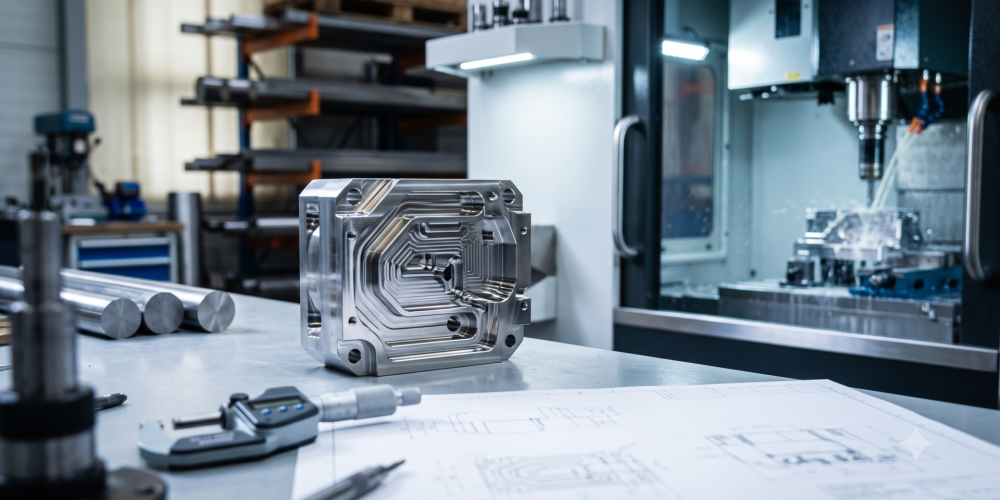
The first question that almost always comes up on a call is: “How many days will it take?” It is a completely fair question; every hour a machine is down is money evaporating. However, an honest answer regarding your true lead time is rarely pleasant, and the supplier who quickly promises “two days” is usually the one who is late most often.
Understanding the lead time for precision component manufacturing will shift your maintenance planning. You will stop evaluating suppliers based on rushed promises and start valuing them for their honest calculations.
Machining Time is Only a Fraction of the Process
The biggest misconception is that lead time equals machining time. For precision components, the time the machine spends cutting is often just a small fraction of the total duration. The rest is consumed by unseen, yet critical, stages:
- Phase 1: Technical Clarity: Drawings must be read, datums understood, and critical features agreed upon. Skipping this step for the sake of speed means making efficient mistakes.
- Phase 2: Material Procurement: Specialty tool steels or heat-resistant alloys are not always on the shelf. Procuring them and verifying their material certificates is a non-negotiable step for critical applications.
- Phase 3: Preparation & Tooling: Creating programs, setting up jigs, and ensuring proper clamping often take longer than the actual machining, especially for job order production and single-unit runs.
- Phase 4: Intermediate Processes: Beyond cutting metal, components require heat treatment, chemical plating, and crucial stabilization time to release residual heat and stress before final measurement.
- Phase 5: Final Inspection: The final hours of your total lead time are spent verifying dimensions and geometry. Rushing this stage compromises the quality and safety of your asset.
Shortening Lead Time Without Sacrificing Quality
There are practical ways to accelerate your turnaround time while maintaining strict precision standards:
- Submit complete drawings and specifications from the very beginning.
- Appoint an authorized person to answer technical queries swiftly.
- Order routine wear components in batches before a crisis occurs.
- Agree upfront on which features are truly critical so engineering efforts are focused correctly.
- Discuss your maintenance timeline with your manufacturing partner well before a machine breaks down.
Capacity and the Prototype Reality
An honest workshop will tell you when their capacity is full rather than silently queuing your job. Transparency about shop capacity and priorities separates a true manufacturing partner from a mere vendor.
Furthermore, the first unit and the hundredth unit have vastly different lead time requirements. The first unit absorbs the “learning cost”—drafting, fixturing, and verification. Because of this, a more strategic question to ask is, “How long for the first unit, and how long for the subsequent ones?” This allows you to build a financially sound backup stock strategy rather than constantly paying emergency prices.
Planning Changes the Relationship
Proper planning transforms you from a constantly panicked customer into a collaborative partner. Clients who adopt this approach consistently experience a shorter lead time, lower costs, and far more reliable quality. An honest lead time is a form of respect for your money.
Has your supplier ever explained their lead time for precision component production stage by stage, or do they just give you a single number without context?