altius23

Shaft Straightening After Hardening: Bringing Runout Back Without Cracking the Case

A batch of induction-hardened rods comes off the quench line looking perfect. On the V-blocks, the dial indicator tells a different story: most rods show 0.1 to 0.3 mm of runout at the middle. Ground or machined as they are, they would end up thicker on one side than the other, or with a hardened

Shaft Straightening After Hardening: Bringing Runout Back Without Cracking the Case Read More »
Diesel Generator Engine Overhaul: Standby Sets, Prime Power, and the Problem of Light Loads

A factory’s standby generator starts perfectly every week during its test run. It idles for fifteen minutes, then shuts down. After four years, the grid fails during a production shift and the generator is asked to carry the full plant load. Within minutes it is smoking heavily, oil is weeping from the exhaust joints, and

Diesel Generator Engine Overhaul: Standby Sets, Prime Power, and the Problem of Light Loads Read More »

Steel Grade for Machined Parts: Matching Carbon, Alloy, and Hardenability to the Job

A replacement shaft is ordered with the note “material: steel.” It is machined from the most readily available bar, fits perfectly, and is installed. A month later the keyway has hammered out and the bearing seat is worn through. The original shaft was a hardened alloy steel. The replacement was soft low-carbon bar. Both are

Steel Grade for Machined Parts: Matching Carbon, Alloy, and Hardenability to the Job Read More »

Bushing Interference Fit: Getting the Press Fit Right So the Bushing Stays Put

A pivot bushing on an excavator arm is replaced during a scheduled service. Two weeks later it has walked halfway out of its housing and the pin is hammering against the bore. The new bushing measured perfectly. So did the pin. Nobody measured the housing, which had worn oval from years of movement. The bushing

Bushing Interference Fit: Getting the Press Fit Right So the Bushing Stays Put Read More »

Thread Rolling Process: Why Formed Threads Outlast Cut Threads Under Load

A component maker switches suppliers to save a little on a threaded rod. The dimensions are identical, the thread gauges pass, and the parts look the same. Within months, field returns arrive: threads stripped during assembly and fatigue cracks at the thread root. The old supplier rolled the threads. The new one cut them. On

Thread Rolling Process: Why Formed Threads Outlast Cut Threads Under Load Read More »

Printing Roller Runout: The Hundredths of a Millimeter That Show Up on Every Print

A flexible packaging printer sees a faint light band repeating at the same interval down the web. Ink viscosity is checked. The plate is replaced. The anilox is cleaned. The band stays. Someone finally puts a dial indicator on an idler roll and watches the needle swing 0.08 mm with every rotation. The repeat distance

Printing Roller Runout: The Hundredths of a Millimeter That Show Up on Every Print Read More »

material blok silinder besi cor dan aluminium

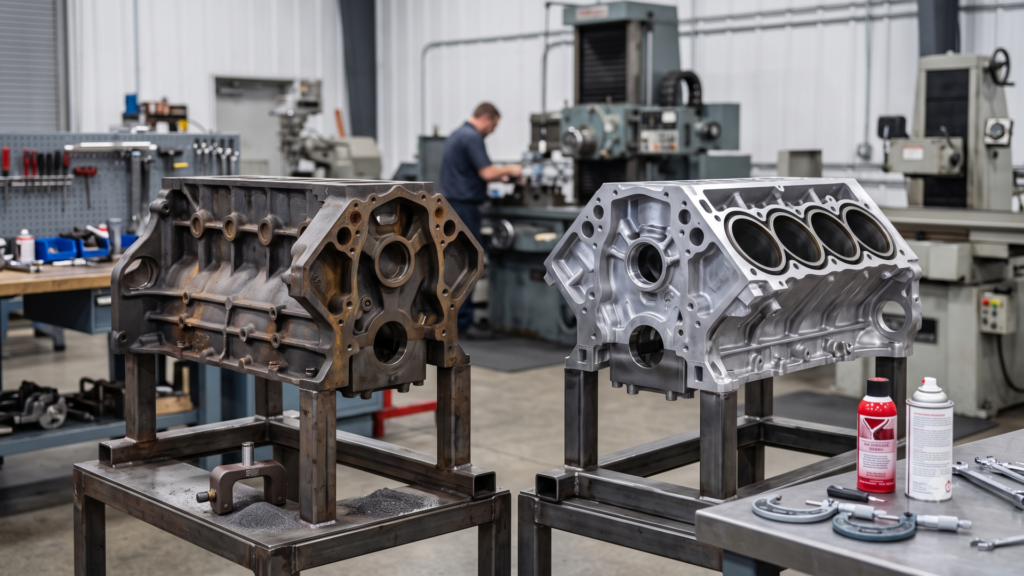
Cast Iron vs. Aluminum: Why Block Material Changes the Entire Repair Plan

Two cylinder blocks stand side by side on our workshop floor. From a distance, they look identical: heavy, dirty, full of holes and ribs. However, once they enter the repair process, almost no steps are identical. The inspection tools are different, the machining sequence is different, the bolt torque is different, and even the cooling

Cast Iron vs. Aluminum: Why Block Material Changes the Entire Repair Plan Read More »

Scroll to Top