
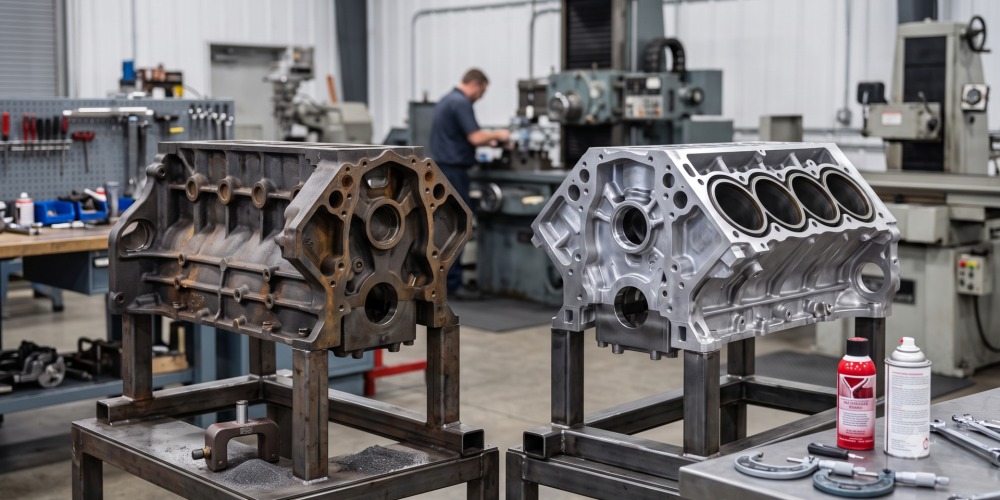
Two cylinder blocks stand side by side on our workshop floor. From a distance, they look identical: heavy, dirty, full of holes and ribs. However, once they enter the repair process, almost no steps are identical. The inspection tools are different, the machining sequence is different, the bolt torque is different, and even the cooling method is different. That difference stems from just one thing: the Block Material.
Understanding the Block Material properties of cast iron and aluminum cylinder blocks is not an academic matter. It is a matter of money. A workshop that treats an aluminum block with cast-iron habits will produce a job that fails in a matter of months, and the failure usually only appears after the warranty has expired.
Non-Negotiable Basic Properties
Gray cast iron has dominated the engine world for over a century for highly logical reasons. It is rigid, cheap, easy to machine, and the graphite within its structure acts as a natural solid lubricant. Cast iron cylinder walls can run directly against piston rings without additional coatings. It also dampens vibrations well, meaning the engine feels smoother and quieter.
When comparing cast iron and aluminum as your engine’s Block Material, aluminum offers things cast iron cannot: lightweight and high thermal conductivity. Aluminum blocks dissipate heat much faster, which aids efficiency and emissions. The trade-off is lower rigidity, strength that degrades faster under heat, and a thermal expansion coefficient nearly twice that of cast iron.
That last figure is the most frequently underestimated. When an engine reaches operating temperature, an aluminum block expands more than the steel bolts securing it and more than the cast iron liners inside it. The entire design of modern engines is built upon these expansion calculations. Repairs that ignore this mean delivering an engine that is only correct when it is cold.
The Four Consequences of Material Differences
- First Consequence: Crack Detection. The Block Material dictates how you find cracks. Cast iron is ferromagnetic, so magnetic particle testing works perfectly and quickly. Aluminum is entirely non-magnetic, making that method useless. For aluminum blocks, the standard is dye penetrant and hot pressure testing. A workshop equipped with only one method will force all components through it, putting your engine at risk.
- Second Consequence: Cylinder Walls. On cast iron blocks, the cylinder wall is the Block Material itself. When worn, you can bore it to the next oversize, hone it with the correct crosshatch pattern, and install oversize pistons. On aluminum blocks, the story diverges. Some use cast iron liners that can be pressed out and replaced. Others use special coatings like Nikasil or Alusil applied directly to the aluminum wall (dozens of microns thick) which cannot be rebored. A single mishandling turns an expensive block into permanent scrap.
- Third Consequence: Heat and Distortion. Aluminum blocks are far more prone to warping from overheating. If an engine runs out of coolant, a cast iron block often survives, while an aluminum block permanently deforms. After machining, aluminum blocks also require stabilization time before measurement because machining heat lingers inside.
- Fourth Consequence: Threads and Torque. Aluminum threads are significantly weaker than cast iron threads. Repeatedly tightening bolts will pull the threads out along with the material. Therefore, thread repair with steel inserts is often a normal part of aluminum block engine reconditioning, not a sign of failure. Additionally, modern engines use torque-to-yield bolts designed to stretch permanently upon installation. Reusing them is the most frequent cause of gasket leaks we encounter.
The Mark of an Expert Workshop
Experienced workshops perform final machining on aluminum blocks while they are bolted down as if installed, often using a torque plate. Tightened cylinder head bolts slightly pull the cylinder bores out of round. On cast iron, the effect is minor; on aluminum, it is significant. Ignoring this produces bores that are round in the shop but oval inside the running engine.
Ask This Before Your Block is Machined
Before proceeding with repairs, ask your potential workshop these questions:
- How do you confirm whether the block is coated or sleeved?
- What crack detection method is appropriate for this specific Block Material?
- Is the final measurement taken after the block has thermally stabilized?
If their treatment is exactly the same for both cast iron and aluminum cylinder blocks, you are speaking to a workshop that operates on habit, not knowledge. Block Material dictates the process, and the process dictates how long your engine will run after returning to the field.
Corrosion, Coolant, and Hybrid Blocks
There is one characteristic difference rarely discussed but that routinely destroys engines: their reaction to coolant. Cast iron faces rust, which builds up slowly and restricts water passages. Aluminum faces electrochemical corrosion, especially when it meets dissimilar metals within the same system. Using plain water in an aluminum block for just one season is enough to eat away the cooling jackets from the inside.
Hybrid Blocks in the Field: Modern engines increasingly combine cast iron and aluminum within a single unit: an aluminum block with cast iron liners, an aluminum cylinder head on a cast iron block, or steel inserts in aluminum bearing housings. Treating a hybrid as a pure aluminum or pure cast iron engine is a costly mistake. In such engines, tightening sequences and torque values are often determined by the weakest Block Material in the chain.
Do you know if your engine uses a cast iron block, an aluminum block, or a combination of both? Contact our team and let’s identify it properly before any repair decisions are made.