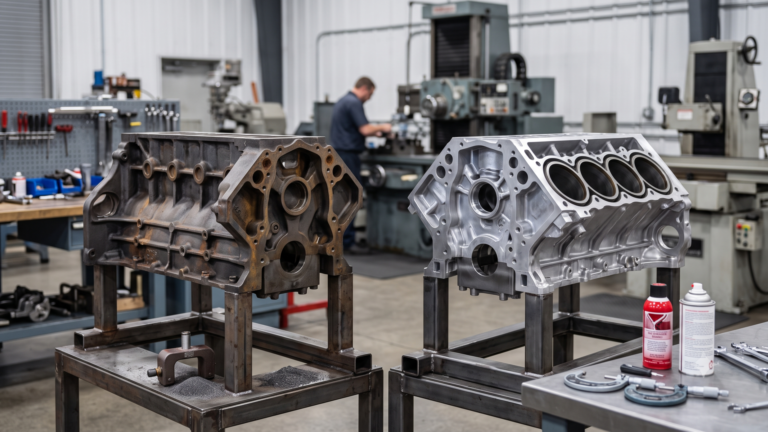
A cylinder block arrives at our workshop with a verdict already handed down by someone else: it has reached its maximum oversize, one cylinder is deeply scratched, just replace the block. The owner has been told that a replacement block must be imported with a four-month lead time. The heavy equipment stops, projects are delayed, and fixed costs keep running every day. This is a story we hear almost every month.
The good news is, that verdict is often wrong. There is a procedure capable of returning a worn-out cylinder back to factory standard size: cylinder block liner installation, or re-sleeving. This procedure is not a makeshift patch. It is serious machining work that becomes the most rational solution when replacement blocks are rare, expensive, or no longer in production. We explain this in more detail in our article on why cylinder bores need honing.
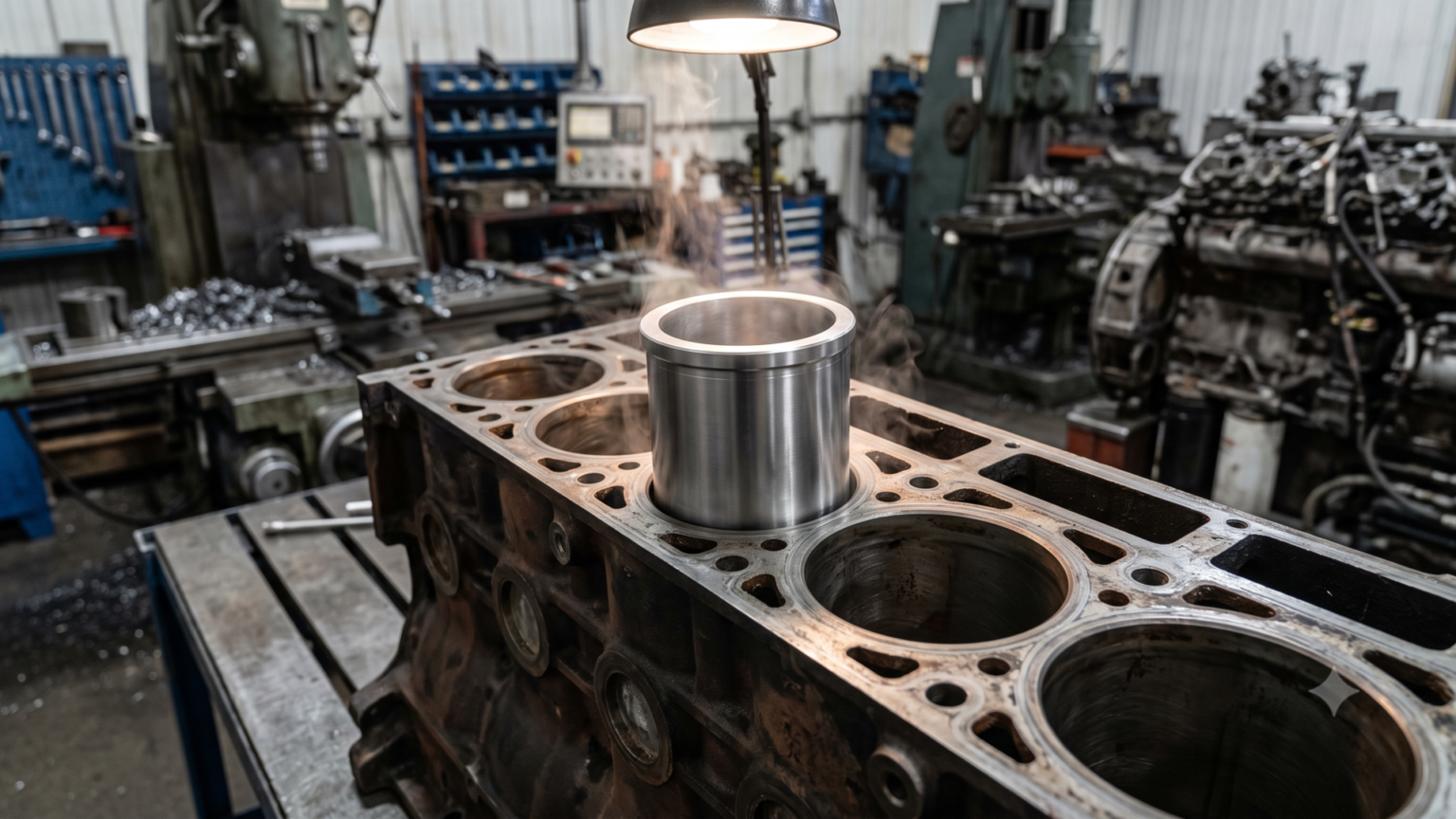
A liner, or sleeve, is a precision cylindrical tube installed into the block’s bore. Once installed, its inner wall becomes the new working surface where the piston moves. There are two basic types:
- Dry liners: Fully in contact with the block material and do not touch the coolant.
- Wet liners: In direct contact with the coolant and sealed with O-rings at the bottom.
Many commercial diesel engines are designed with wet liners from the start. What we are discussing here is different: machining a solid cast iron block to accept a dry liner, returning it to work with standard-sized pistons.
When Re-Sleeving is the Right Choice (And When to Stop)
Re-sleeving is the ideal choice under a few specific conditions:
- Maximum Oversize Reached: There are no more oversize pistons available.
- Deep Scratches: Caused by broken piston rings or foreign objects, where normal boring would make the cylinder wall too thin.
- Obsolete Parts: For old generators or heavy equipment, re-sleeving changes the question from “where do I find a block?” to “when can my engine run again?”
- Time Constraints: Waiting four months for an imported block is almost always more expensive than a liner job completed in a matter of days.
However, technical honesty demands we state the limits. If the block is cracked through the main bearing tunnel, if the deck surface has been machined past its service limit, or if the walls between cylinders are too thin to accept a liner safely, then re-sleeving is not the answer. Forcing it means wasting money on a block that will fail again. We prefer to say no upfront rather than accept a job we know will not last.
The Re-Sleeving Process
Every cylinder block repair service that leads to re-sleeving follows these essential steps: See also our article on engine block material and repair.
- Full Inspection: Crack testing, deck flatness measurement, and main bearing tunnel geometry checks. There is no point in sleeving a block with fatal flaws elsewhere.
- Determining Specifications: Calculating the material, wall thickness, and most critically, the interference fit. If it is too loose, the liner will shift and lose thermal contact. If it is too tight, the block could crack.
- Precision Boring: Machining the block bore perfectly parallel to the crankshaft axis.
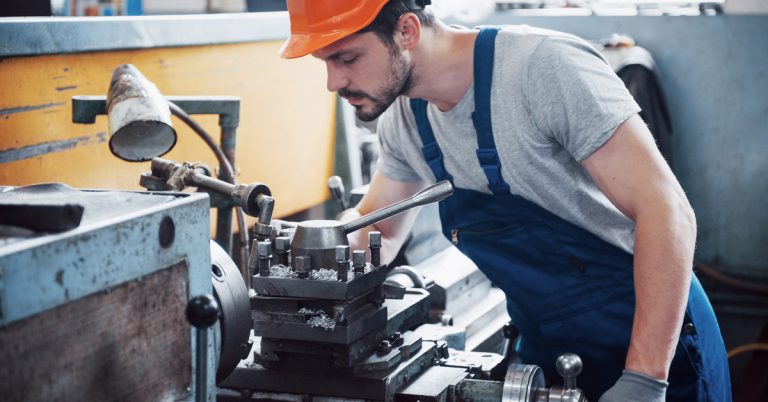
- Thermal Installation: Using temperature differences to install the liner. We cool the liner so it shrinks, or heat the block so it expands. This is far safer than using brute force, which risks scratching the walls.
- Final Machining: The final step of re-sleeving ensures the liner is cut flush, bored, and honed to standard piston size using a torque plate.
Crucial Details for a Lasting Repair
For popular engines, liners are available off-the-shelf. For rare or special engines, our precision manufacturing team can turn custom liners from suitable materials, specifically calculated for the block in front of us. Remember, returning the cylinder to standard size means pistons, rings, and connecting rods must also be re-evaluated to ensure the whole assembly balances perfectly.
Two microscopic details define the success of this job:
- Liner Protrusion: The lip of the liner often needs to sit a few hundredths of a millimeter above the deck. This exact protrusion creates the edge pressure on the gasket needed to hold extreme diesel combustion pressures. Too low means a blown gasket; too high distorts the bore.
- Perfect Thermal Contact: Dry liners transfer heat physically. If the block’s bored surface is wavy, trapped air will cause local overheating, expanding the piston too fast and causing catastrophic friction at a single point.
Through a correct re-sleeving process, your engine will return to work at standard dimensions, with equivalent cooling and lifespan. This ties directly into forklift engine overhaul.
Do you have an engine block in your warehouse deemed dead by someone else? Before you sell it as scrap metal, let us determine if re-sleeving can revive it. Contact our team and let us give you a proper verdict based on hard measurement data. This work is part of our engine reconditioning for fleets and industrial engines.
Recent Posts
Have a drawing or a worn part?
Send it to us and our team will get back to you with a quotation.
Request a Quote +62 21 5522564