
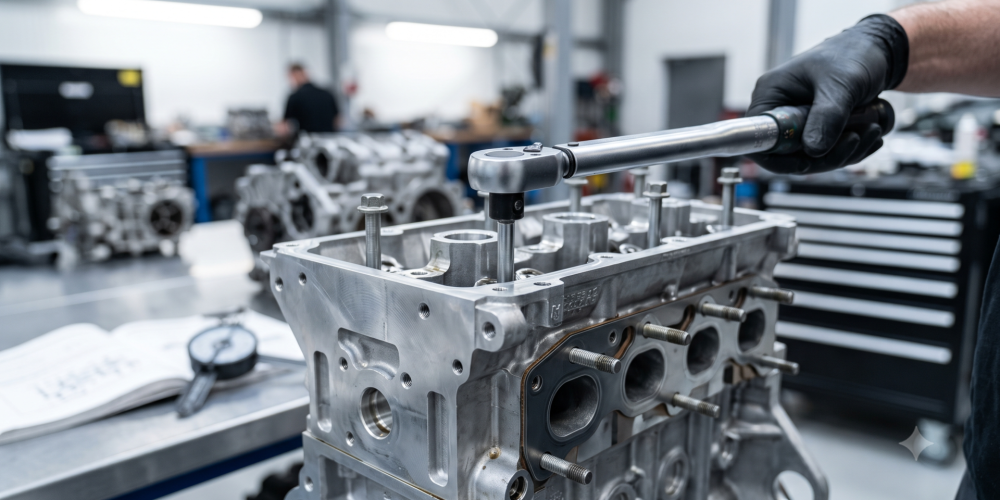
A cylinder head undergoes extensive work—crack testing, pressure testing, valve jobs, and precise surface machining. Yet, tens of hours and significant costs can be destroyed in the final five minutes by someone applying Cylinder Head Torque randomly based on “feel.” Proper Cylinder Head Torque and bolt tightening sequences are not trivial details; they are the deciding factor between a successful repair and a blown budget.
Bolts Are Springs, Not Just Fasteners
Understanding this core engineering concept changes how you view the entire assembly process.
- Bolts Act Like Stiff Springs: When tightened, a bolt stretches by hundredths of a millimeter. Generated by proper Cylinder Head Torque, this stretching creates the pulling force that presses the cylinder head to the cylinder block and seals the gasket, not the physical strength used to turn the wrench.
- Torque is a Flawed Measure: Most Cylinder Head Torque applied to a wrench actually fights friction under the bolt head and along the threads. A dirty thread or unlubricated bolt drastically alters the actual clamping force, making torque numbers deceiving if the thread condition is ignored.
- Beware of Hydro-Lock: Blind bolt holes filled with oil or coolant act as hydraulic cylinders when a bolt is inserted. Because liquids cannot be compressed, the resulting pressure can permanently damage threads or crack the block. Holes must be clean and dry.
The Critical “Inside-Out” Sequence & TTY Bolts
Cylinder heads are not perfectly rigid; they will warp and twist under uneven force.
- The Center-Outward Spiral: Tightening from the center outwards pushes air and stress out evenly, ensuring the head sits flat. This is done in gradual stages to let the component adjust before adding more load.
- Torque-to-Yield (TTY) Bolts: Many modern engines use TTY bolts designed to stretch past their elastic limit for highly consistent clamping force. Because they stretch permanently, they are strictly single-use components.
- Torque-Plus-Angle Method: TTY bolts use an initial low Cylinder Head Torque followed by a specific degree of rotation (using an angle gauge). This measures stretch directly, bypassing friction variables. Reusing TTY bolts is the most expensive way to save a few dollars.
The Hidden Victims of Uneven Tightening
Incorrect Cylinder Head Torque and an improper tightening sequence affect much more than just the head gasket.
- Distorted Cylinder Bores: Unbalanced clamping forces pull the underlying cylinder bores out of round (especially in aluminum blocks), preventing piston rings from sealing and causing unexplained oil consumption.
- Misaligned Bearings: A twisted block can alter the straightness of the main bearing tunnel, forcing the crankshaft to bend during operation and damaging multiple systems at once.
- The Retorquing Myth: Older engines with composite gaskets often require retorquing after initial operation. However, modern engines with Multi-Layer Steel (MLS) gaskets and TTY bolts strictly forbid it, as it stretches the bolts past safe limits. Always respect the engine manual over personal habits.
Precision is about refusing to guess, even on the final steps. That is why professional workshops calibrate torque wrenches to ensure accurate Cylinder Head Torque, clear blind holes, and document every stage of assembly.
Does your assembly team have the exact Cylinder Head Torque specifications, angle degrees, and tightening sequence for the engine you are building today? If you need clarity on your engine reconditioning specifications, contact our team to ensure your assembly is done right the first time.