
There is one common mistake that routinely costs heavy equipment owners tens of millions of rupiah. The mistake is simple: paying full price to recondition a cylinder block that was already suffering from invisible engine cracks from the start. All the work is done neatly, new components are installed, the engine is reassembled, and within weeks, the oil mixes with water again. The budget is burned, time is lost, and the root problem was never actually addressed.
Hairline cracks will not announce themselves. Their width can be just a few microns, easily hidden under carbon buildup, oil, and rust. The human eye, even that of a highly experienced technician, is not designed to spot them. Therefore, crack testing for engine components is not an optional step to skip when budgets are tight. It is the crucial first gateway that determines whether any subsequent work is actually worth doing.
All standard crack testing methods fall under Non-Destructive Testing (NDT). This means the component is inspected down to the finest detail without being cut, drilled, or damaged. You get your answers, and your component remains intact.
Non-Destructive Testing Methods: How We Find The Invisible Engine Cracks
The three most relevant methods for the engine reconditioning world to uncover invisible engine cracks are dye penetrant, magnetic particle, and pressure testing.
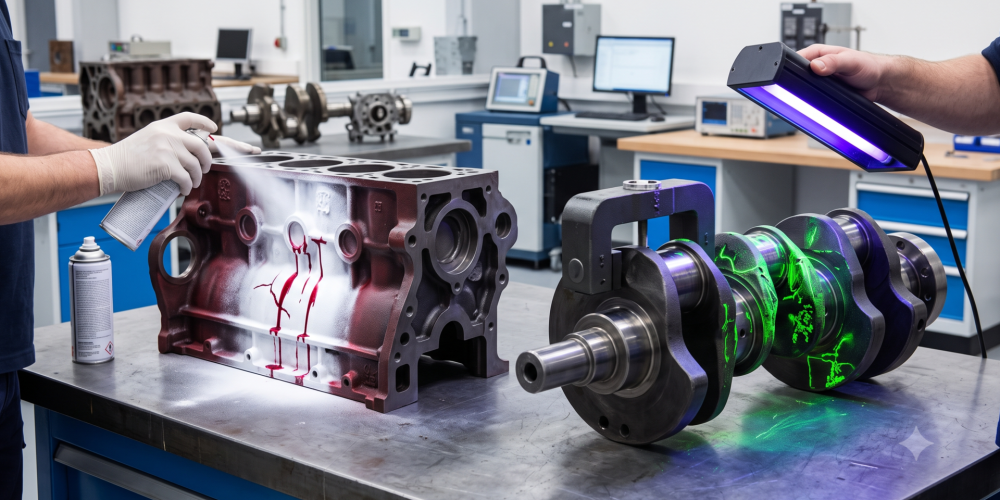
1. Dye Penetrant: The Liquid That Refuses to Lie This method works like ink seeping into paper. The component’s surface is thoroughly cleaned until free of oil and scale, as even the smallest speck of dirt will hide a crack. A red or fluorescent penetrant liquid is sprayed and left to seep. Capillary action draws the liquid deep into any invisible engine cracks. After wiping the surface clean, a white developer is applied. It acts like blotting paper, drawing out the hidden liquid to form a sharp red line.
- Advantage: Works on almost all materials, including non-magnetic aluminum, brass, and stainless steel.
- Limitation: It only finds surface-breaking cracks.
2. Magnetic Particle: Reading Leaking Magnetic Fields This applies only to ferromagnetic materials like cast iron and steel. A magnetic field is applied to the component, and fine iron powder is distributed over the surface. If there is a crack, the magnetic field leaks, and the iron powder gathers there to form a highly contrasting line (often called magnafluxing).
- Advantage: Faster and more sensitive than dye penetrant; catches invisible engine cracks just below the surface.
- Crucial Step: Components must be demagnetized afterward. If skipped, residual magnetism will pull metal shavings from the oil directly into the bearing clearances.
3. Pressure Testing: The Final Honest Exam While the previous methods are visual, pressure testing checks if the component can hold pressure at operating temperatures. Water passages are sealed, filled with compressed air, and submerged in hot water. Escaping bubbles provide undeniable proof of a leak. Testing in hot water is vital because metal expands, and some invisible engine cracks only open up once the engine reaches operating temperature.
Choosing the Right Method & What to Ask
For cast iron components, magnetic particle is the fast and reliable first choice. For aluminum (like most modern cylinder heads), dye penetrant is the answer. Any component involving coolant circulation must undergo hot pressure testing. These methods are not mutually exclusive; they are complementary layers of defense.
We always test before machining to ensure the component is viable, and after major work (like resurfacing or installing liners) because machining can expose invisible engine cracks that were previously buried under the surface.
Questions You Should Ask Your Workshop:
- What crack testing method do you use, and why choose it for this material?
- Are tests performed both before and after machining?
- Can you provide photos or a written report of the inspection results?
Note: If a workshop claims they can “just look at it and tell,” consider it a massive red flag. The cost of proper testing is always a fraction of the cost of tearing down an engine that fails after assembly.
Why Cracks Happen and When They Can Be Fixed
Finding invisible engine cracks is only half the job. The other half is diagnosing why it happened. If the root cause isn’t fixed, your replacement component will suffer the exact same fate.
- Valve seat cracks often indicate a history of severe overheating.
- Water jacket cracks point to past freezing or poor coolant quality.
- Block deck cracks can stem from improperly torqued bolts.
Repairing Cracks Some cracks can be repaired using metal pinning or stitching, which restores strength without the warping heat of welding. However, viability strictly depends on the location, length, and load-bearing nature of the area. Cracks crossing valve seats or penetrating main load paths are generally unrepairable, and we will tell you so upfront.
Are you sure the component you are reconditioning today is truly free of invisible engine cracks based on standard NDT methods, or does it just look clean after a wash? Contact our team to discuss the proper inspection process before you spend your budget on a full reconditioning.